
In this blog we’re going to look at how winery-to-consumer shipping became the consumer rights issue that it is, and went from almost nowhere to nearly everywhere over the course of 40 years, and why the fight isn’t over.
Before the fight: Prohibition and wine bricks
Shipping wine to people’s homes isn’t a new idea. Even during Prohibition, grape growers sold “wine bricks”, blocks of pressed grape concentrate for home use, sometimes with a tongue-in-cheek warning not to dissolve them in water and leave them in a jug, or they might turn into wine. Even then, the demand for wine at home stayed strong.
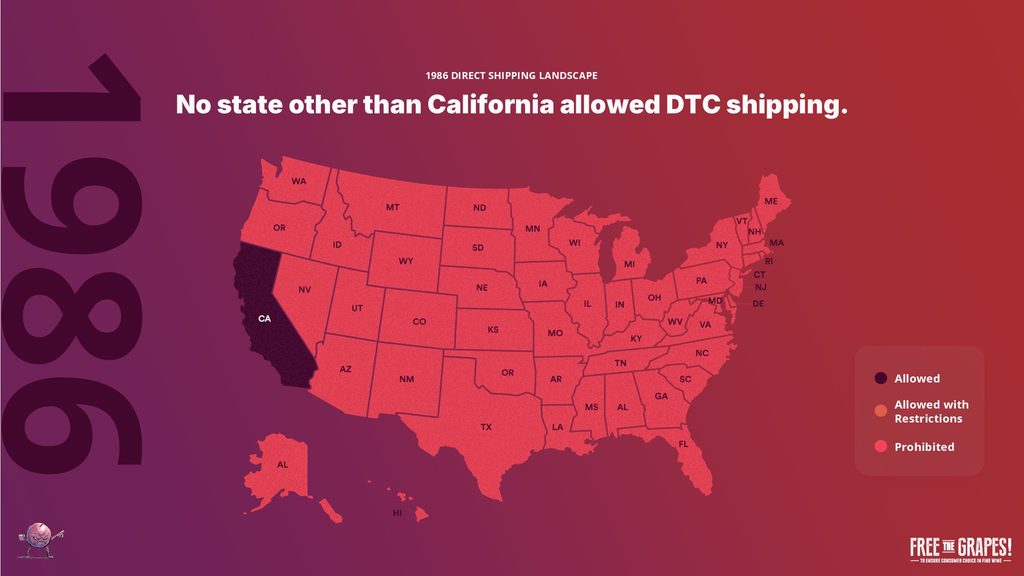
Fast forward all the way to 1986, and California is the first and only state open for DTC shipping. The pace of change was slow. Other states started to open up, for example Wisconsin joined in in 1988, but often a state would “open” with significant restrictions in place, really limiting what was possible.
1986–1997: From one open state to a felony
In 1997, a bill was introduced in Florida that would make winery-to-consumer shipping into that state a felony. Unfortunately, it did pass into law at the time, and Georgia and North Carolina adopted similar penalties that same year. But that fight galvanized the effort to change restrictive DTC shipping laws around the country. Even at the time, people recognized how important this channel could be for the wine business, and this was when the internet was still relatively in its infancy.
2005: Granholm v. Heald goes to the Supreme Court
Jump to 2005, just before the Supreme Court’s decision in Granholm v Heald. At the time, total wine sales in the U.S. (across all channels) were about $20 billion, and direct shipping made up about 2% of this, or about $400 million. But it was recognized as a key area for potential growth. Yet, direct shipments could reach less than 51% of the adult population.
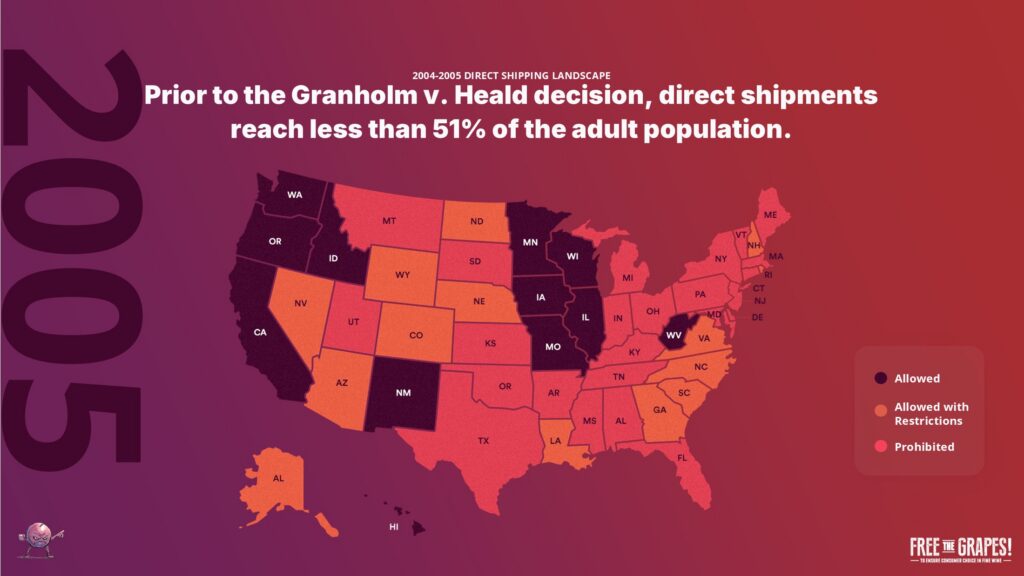
On this map, the states in the darkest color were fully open to direct shipping. States in orange were open, but with a variety of restrictions, large and small. And the states in pink prohibited direct shipping at the time.
Two lawsuits, Granholm v Heald (challenging Michigan’s law) and Swedenberg v. Kelly (challenging New York’s), made it to the Supreme Court, which combined them to review the question of whether the 21st Amendment permits states to enact regulatory schemes that discriminate in favor of in-state wine producers.
The unifying point in both of these cases was the idea that if a state allows in-state wineries to ship wine directly to consumers, then the state should also allow out-of-state wineries to do the same. At the time, both Michigan and New York, and other states, had these protectionist policies in place, which gave in-state wineries rights that out-of-state wineries did not have. This is why both Michigan and New York appear pink on this map. They prohibited out-of-state wineries from shipping into the state.
It’s worth separating this from reciprocity, a concept that shaped many state shipping laws at the time. Reciprocity said, in effect: “a winery in your state can ship to a consumer in my state, only if a winery in my state can ship to a consumer in your state.” The Granholm cases argued for something more basic: equal treatment, no matter where the winery was located.
What Granholm did, and didn’t, do
The arguments in the Supreme Court case turned on how two parts of the Constitution fit together: the 21st Amendment, the one which repealed Prohibition and gave states broad power over alcohol, and the Commerce Clause. Courts have long read the Commerce Clause to include an implied limit on the states, known as the Dormant Commerce Clause, which bars laws that discriminate against out-of-state businesses. The question was whether the 21st Amendment overrode that limit when it came to alcohol.
This was not the first, and certainly not the last, time that this question has been examined like this. In May 2005, the Court ruled that it did not - states can regulate alcohol, but they cannot discriminate against out-of-state wineries in favor of in-state ones. If a state lets its own wineries ship directly to consumers, it has to give out-of-state wineries the same opportunity.
All of this being said, the Granhom decision (as it has come to be called) didn’t open every state overnight. The ruling required equal treatment, not open shipping. Let all wineries ship, or let none ship. As the laws concerning this commerce and shipping ultimately remain the bailiwick of the states, it is still up to each state to decide how to proceed. But many states did follow the decision and opened up for DTC shipping as a result. But not all.
Where DTC shipping stands today
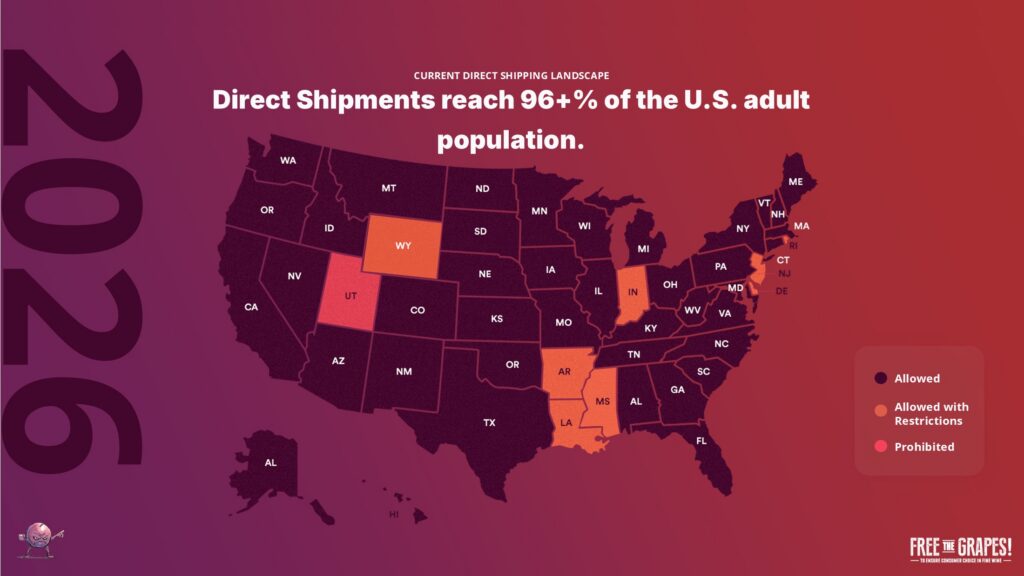
Today, DTC is roughly a $4 billion sales channel, according to Sovos ShipCompliant and WineBusiness Analytics reports. 49 states are open for DTC shipping, reaching the majority of U.S. adults. Only one state, Utah, still bans shipping entirely. And that’s real progress from just two years ago, when three states (Delaware, Mississippi, and Utah) still banned shipping. Mississippi’s new law took effect in July 2025, and Delaware’s new law passed in 2025 and went into effect August 2026.
Several states do still have significant restrictions in place, though. One example is New Jersey which maintains a capacity cap, disallowing wineries that produce over a certain amount of wine from shipping into the state. And perhaps most commonly, there’s often just a lot of confusion about how the laws are defined, what the requirements are around shipping in each state, and whether the rules are changing. Opening up that final state that bans shipping, as well as removing the significant restrictions in other states, remains a top goal for Free the Grapes!
Want to help? Sign up for Free the Grapes! alerts at the bottom of this page to hear when shipping laws in your state are in play, and to send a letter to your legislators when it counts.